


By: Kevin Brenner, Esquire
I’m hearing a surprising version of the same question from clients lately: “Do we still need to care about the FCPA?”
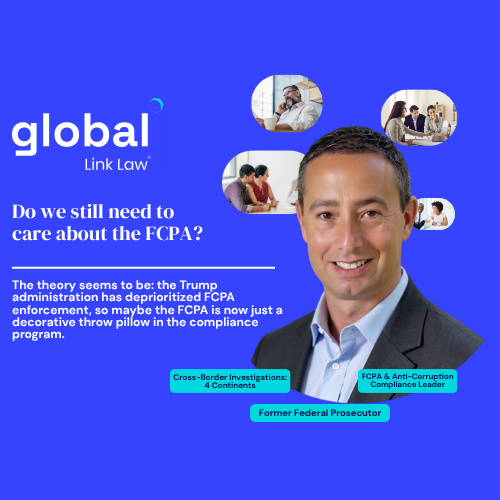
The theory seems to be: the Trump administration has deprioritized FCPA enforcement, so maybe the FCPA is now just a decorative throw pillow in the compliance program.
For purposes of this post, I’m going to put aside the ethics of bribery. I’m also not going to spend much time on the well-established point that corruption is bad for business generally: it distorts markets, rewards the wrong counterparties, invites fraud, creates off-book expectations, and tends to attract the kind of “partners” whose due diligence files age like unrefrigerated seafood. All true. But even if we look at this through the coldest possible risk-management lens, ignoring the FCPA is still a bad bet.
Yes, the administration tapped the brakes on DOJ’s FCPA enforcement in 2025. But tapping the brakes is different from removing the engine. DOJ’s June 2025 guidance redirected prosecutors toward priority cases, including matters tied to cartels, transnational criminal organizations, U.S. national interests, and individual misconduct. That is a shift in prosecutorial focus. It is not a hall pass for bribery, and it is definitely not a coupon code for “one free improper payment.”
DOJ has not left the field. FCPA enforcement certainly dropped in 2025, with seven DOJ actions versus 28 in 2024, about $118 million in total fines versus $1.58 billion in 2024, and no SEC FCPA enforcement actions.[1] Still, DOJ’s FCPA Unit had three corporate enforcement actions in 2025, including a Liberty Mutual declination involving alleged India bank bribes, a DPA with TIGO Guatemala, and the Smartmatic indictment, the FCPA Unit’s first corporate FCPA indictment in more than 15 years. DOJ also reported five individuals charged or unsealed, six individuals convicted, and two FCPA trial wins in 2025. And 2026 has already produced an FCPA and money laundering trial conviction involving alleged bribes to Egyptian officials tied to nearly $140 million in coal supply contracts.
Healthcare and life sciences companies should pay particular attention. In March 2026, DOJ resolved an FCPA investigation involving Balt SAS, a French medical device company, and separately indicted a U.S. subsidiary executive and consultant over alleged bribes to a physician at a French state-owned hospital to drive purchases of medical devices. DOJ declined to prosecute Balt after voluntary self-disclosure, cooperation, and remediation, but Balt agreed to pay approximately $1.2 million in disgorgement. French authorities also entered into a coordinated resolution requiring Balt USA to pay a €1,765,493 fine and complete a three-year anti-corruption compliance program under the supervision of the French Anti-Corruption Agency, with Balt funding costs up to €700,000. That is a current reminder that healthcare-sector bribery risk did not disappear with the enforcement pause. If your business model involves hospitals, government payors, public tenders, physicians at state-owned institutions, distributors, consultants, or “market access” arrangements, the FCPA is still very much in the room.
There is also the statute-of-limitations problem. Criminal FCPA anti-bribery violations generally carry a five-year limitations period, and books-and-records/internal-controls violations carry a six-year period. Conspiracy allegations, tolling for foreign evidence, and continuing conduct can push the practical exposure window much further. Translation: a payment approved today may still be sitting in the file when a future DOJ decides it has rediscovered jazz hands for foreign bribery.
Federal DOJ is also only one guest at this party. California has already reminded businesses that the FCPA remains binding federal law and that violations may be actionable under California’s Unfair Competition Law. Other states with unfair competition or UDAP statutes may try similar theories, including New York-style consumer protection theories where the facts support a state nexus. Outside the U.S., the UK Bribery Act still prohibits bribery of foreign public officials and includes a corporate failure-to-prevent-bribery offense, with an adequate-procedures defense. The UK, France, and Switzerland also launched an International Anti-Corruption Prosecutorial Taskforce in 2025 to increase cooperation on bribery and corruption cases. Add foreign regulators, counterparties, auditors, lenders, acquirers, whistleblowers, and boards, and the “DOJ is quieter right now” argument starts to look less like strategy and more like a calendar-based compliance program.
So the answer to “Can we ignore the FCPA now?” is simple:
No. And please do not put that question in writing.
There is another practical reason not to invite an FCPA investigation into your life. Even if a company ultimately avoids charges or penalties, an FCPA investigation is not a harmless inconvenience. It is expensive, disruptive, and time-consuming. It means collecting years of emails, chats, contracts, invoices, approvals, expense reports, due diligence files, and accounting records. It means interviews, privilege calls, board updates, auditor questions, shareholder and lender questions, customer concerns, and a lot of very busy people spending their time reconstructing old decisions instead of running the business. “We probably won’t get charged” is a poor reason to create the kind of record that requires that exercise.
Enforcement priorities change. Statutes, emails, accounting entries, whistleblowers, and bad facts have a much longer shelf life. Companies should keep anti-corruption controls in place, continue risk-based diligence, investigate reports and other red flags, and not mistake a temporary enforcement posture for permission.
I’m curious what others are seeing: are executives actually treating the current FCPA enforcement posture as a compliance reset, or is this mostly hallway bravado?
[1] With thanks to my friends at WilmerHale.
The information provided on this website is for general informational purposes only and should not be considered legal advice. No attorney-client relationship is created by accessing or using this website. Please consult with a qualified attorney before making any legal decisions. Global Link Law is not liable for any reliance on the information provided. Prior results do not guarantee a similar outcome.